They sold the plan before they saw the lawn.
America's number-one lawn service wanted to sell online for the first time. Nobody could document how selling actually worked inside their own call centers, and leadership had already decided complex services like tree and shrub care could not be sold digitally. To find out what was really going on, I went undercover as a new hire in the call center — and rebuilt the buying process around what customers actually needed to trust before they would ever hand over their credit card.

The value, in twenty seconds.
TruGreen had never sold its core services online. The sales process lived in call centers and with field technicians, no two people sold the same way, and leadership had already ruled out complex services as digitally unsellable. Nobody had documented the real employee or customer experience — so nobody could see which business processes had to change.
I went undercover as a new hire in the call center, questioned lawn technicians, and ran 500+ customer surveys. That research rebuilt the buying journey around an evaluation-first flow customers trusted, unlocked online purchase for services leadership had said could not be sold digitally, and turned a repeated customer complaint about rotating technicians into a Virtual Technician feature.
TruGreen launched online service purchasing for the first time in company history. Previously unsellable services became available digitally. The evaluation-first flow, the Virtual Technician, and a customer journey every internal group helped build became the foundation for how TruGreen would sell going forward.
America's largest lawn care company. Zero online sales.
TruGreen was — and is — the number-one lawn service in the United States. Their entire sales motion ran through call centers and field technicians. Every quote, every plan recommendation, every treatment schedule was negotiated by a human, and each of those humans had their own way of doing it.
The mandate from the top was clear: build a way for customers to buy TruGreen services online. The mandate came with a caveat: complex services like tree and shrub care, the argument went, could not be sold digitally because they required a technician's eyes on the lawn first.
The problem was upstream of the design work. There was no documented picture of how selling actually happened inside TruGreen. Without that, there was no way to know which business processes needed to change, which could stay, and which of leadership's assumptions about what customers would tolerate online were actually true.
Designing an online sales channel for a company that had never sold online before.
No two salespeople in the call center sold the same way. Training documents did not match what actually happened on calls, and leadership's model of how a sale worked did not match what customers were experiencing.
Leadership had ruled out entire service categories — tree and shrub, complex diagnostics — as impossible to sell digitally. The assumption was that customers needed a technician on-site before they would buy. That belief needed to be tested, not accepted.
Salespeople were trained to pitch the highest-tier plan before they knew anything about the customer's lawn. Customers heard the pitch, felt sold-to, and did not trust the recommendation. The default script was actively working against the sale.
The single most common complaint in the research was that customers rarely saw the same technician twice. Each visit meant re-explaining the lawn, the history, and the concerns. Trust was leaking on every rotation.
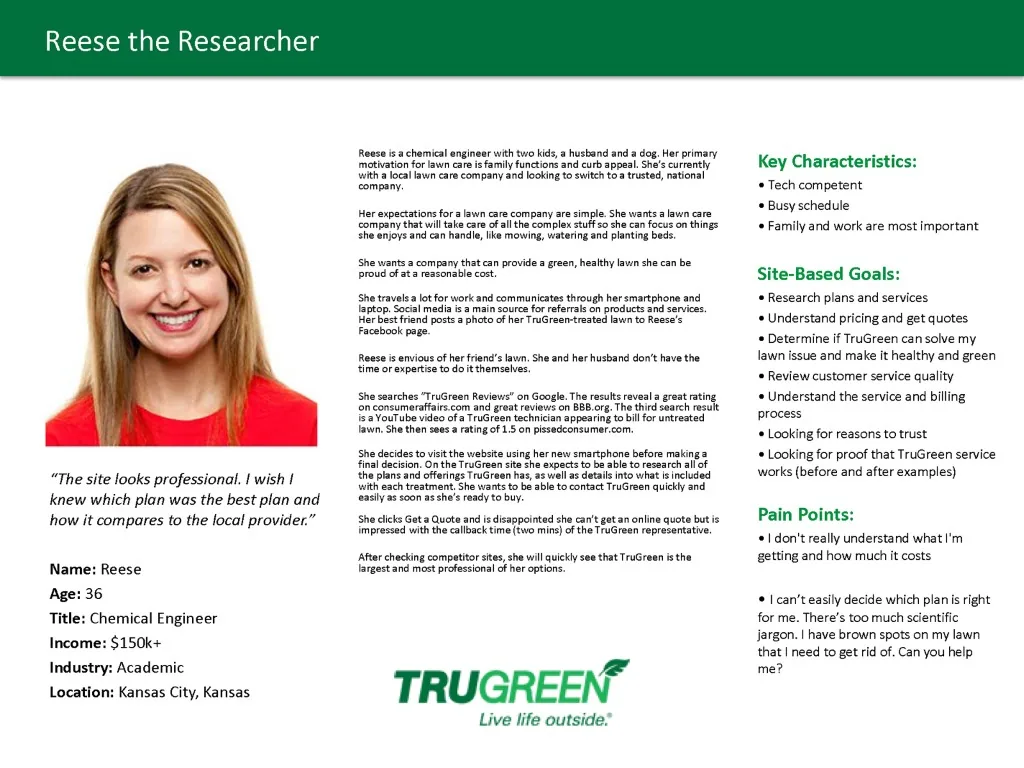
The personas TruGreen was designing against described who leadership thought their customer was — not who actually appeared in the call logs, the search-result review videos, or the surveys. The gap was quiet, and it was expensive.
Marketing, sales, operations, technicians, and support each held one arc of the customer's experience. None of them owned the whole. Any online buying flow would need alignment none of them had yet.
Went undercover in the call center. Nobody in the meeting had done that before.
The design work here started with me getting hired as a new sales employee, sitting in a TruGreen call center, and taking real customer calls. That is where the assumptions leadership had been operating on met the actual sales floor. Everything downstream — the evaluation-first flow, the Virtual Technician, the journey map, the personas — traces back to that seat.
Learn about the framework →I led UX on the TruGreen engagement as a consultant through Publicis — one UX expert, three developers, a visual designer, and a project manager who doubled as UX director. On top of the UX design work I took on the research seat and the business-analyst responsibilities, because both of those chairs needed filling and the answers we needed were not coming out of either without them.
The engagement ran over eight-plus months. Two weeks of discovery — including the undercover call-center placement and 10 internal interviews — set the foundation. Six weeks of design and testing produced the evaluation-first flow and the Virtual Technician. Iteration continued from there, with usability sessions, sitemap and IA work, competitive study, and final UI for mobile and web.
The story that stayed with the team afterwards was the undercover placement. Anyone can run a research plan. Choosing to go get hired at the client, sit in the seat, and take real customer calls before drawing a single screen — that is the piece that made the redesign hold up when it hit reality.
Two artifacts that reset the scope.
The business process map put every group that touched a sale in one room, with the supporting technology on the wall, and forced the trade-offs into the open. The 500+ survey said clearly what customers did not understand and did not trust. Together they set product strategy and scope for the year that followed — and made the case that leadership's "impossible to sell online" list was smaller than they thought.
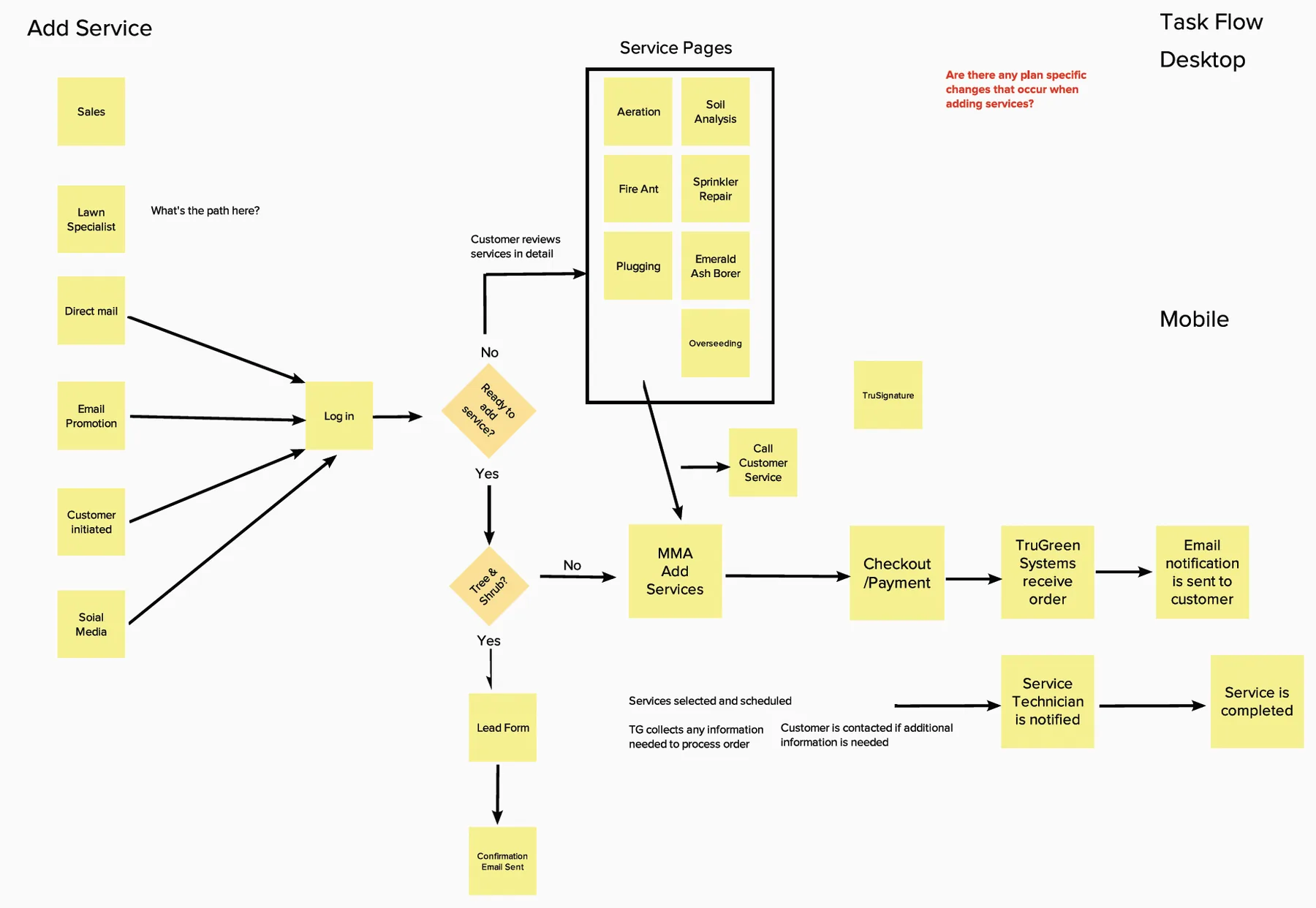
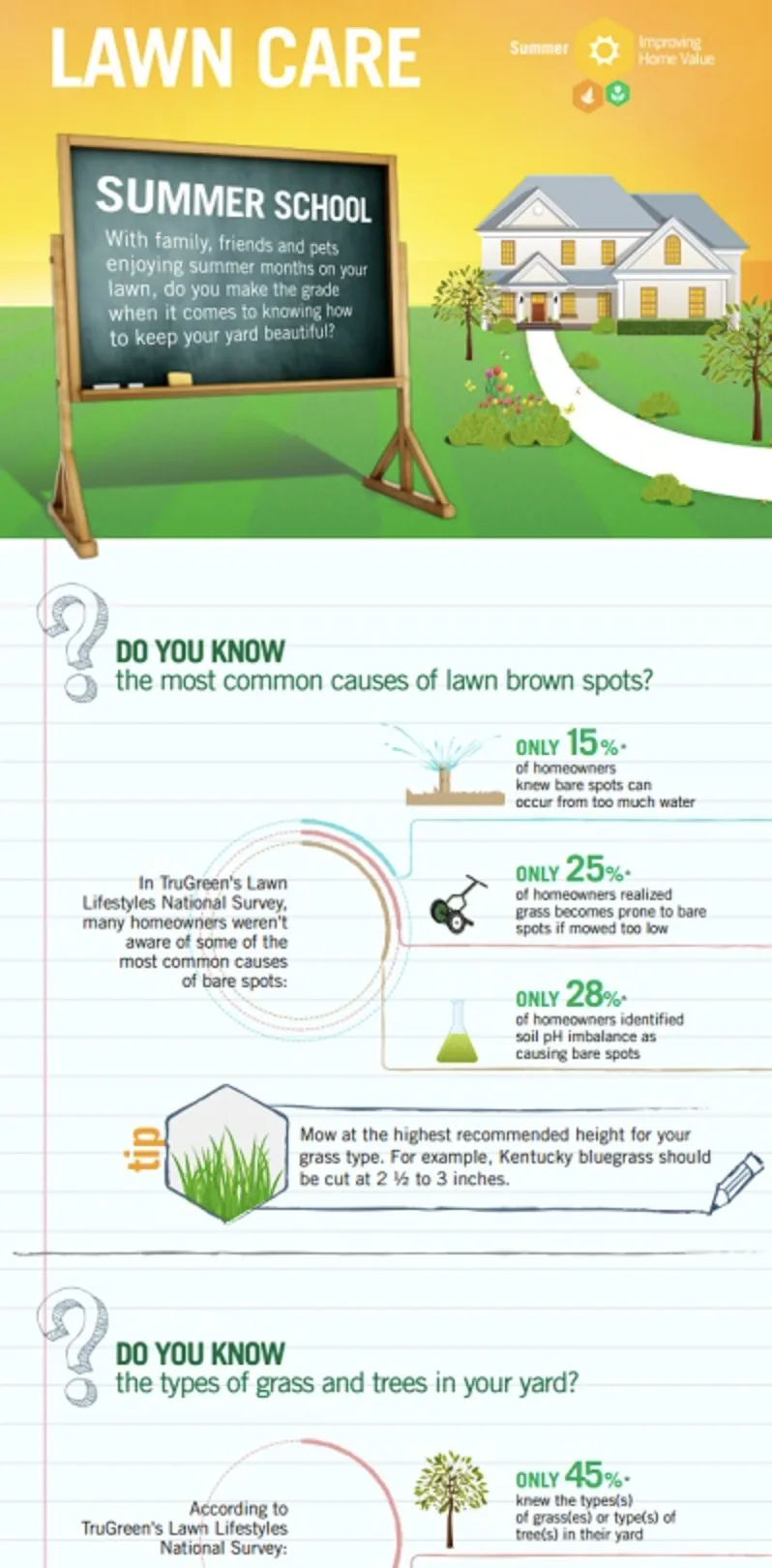
The case for an evaluation-first flow, in one sentence from the person paying for it.
I built a fully functional Axure prototype of the new flows and put it in front of real customers — four tests in the first round, three more after iterating on what came back. The clip below is from a session with a longtime TruGreen customer, asking how the company can recommend a plan without knowing anything about their lawn. That question is the case for an evaluation-first buying flow, in one sentence from the person paying for it.
Usability session with a longtime TruGreen customer. Recorded during the second round of testing after the evaluation-first flow was in the prototype.Hosted on Vimeo. Session recording used with permission.
"How can TruGreen recommend a plan without knowing anything about my lawn?"
A customer journey built for executives — and it changed where design attention went.
The customer journey map was built to give C-level executives visibility into the whole buying arc. Once they could see it, the pain concentrated at consideration and loyalty stages became impossible to argue with — and those stages got the design attention they had never received before. Alignment was the point. The picture was the artifact that produced it.
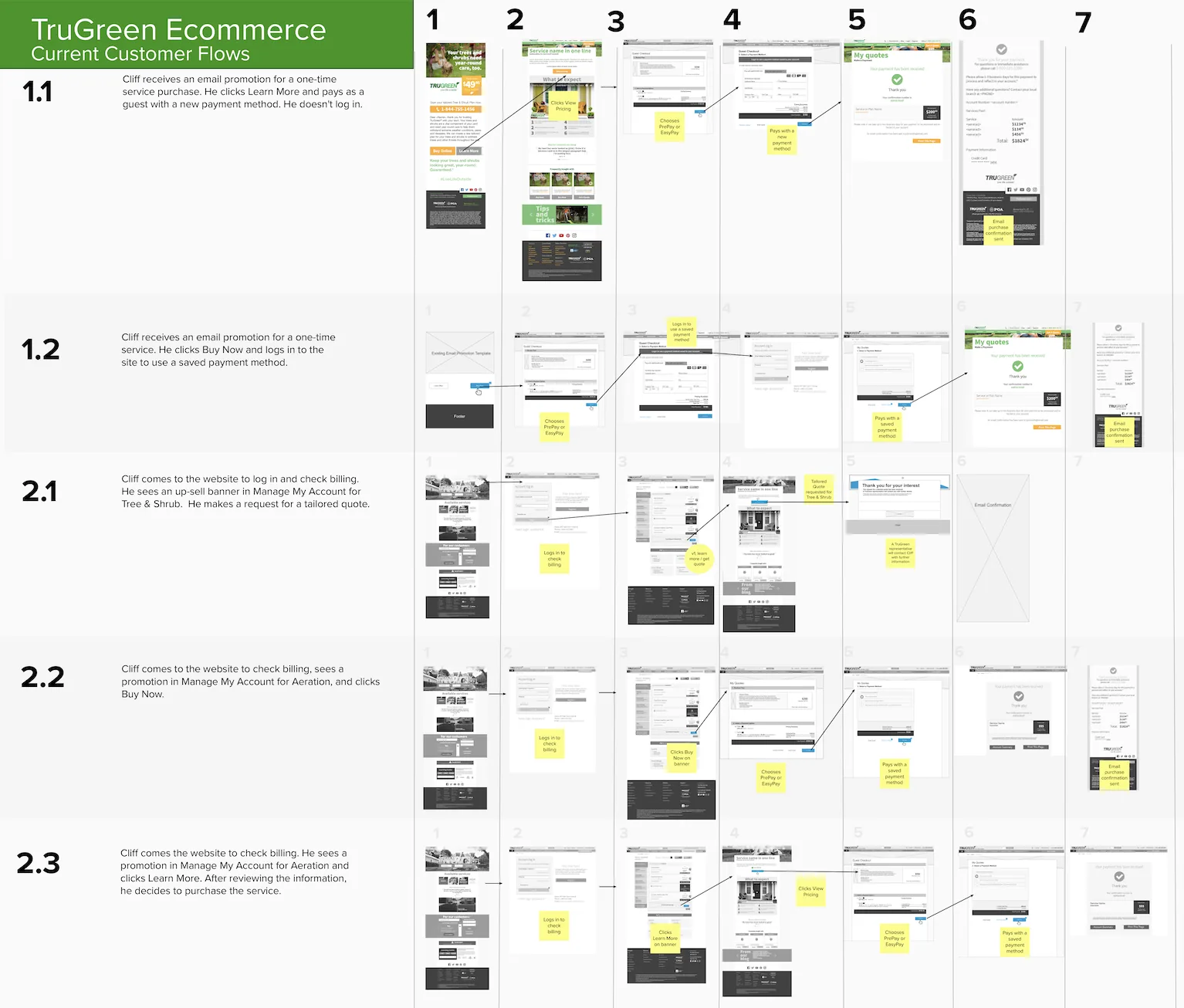
The most common complaint in the research, turned into a feature.
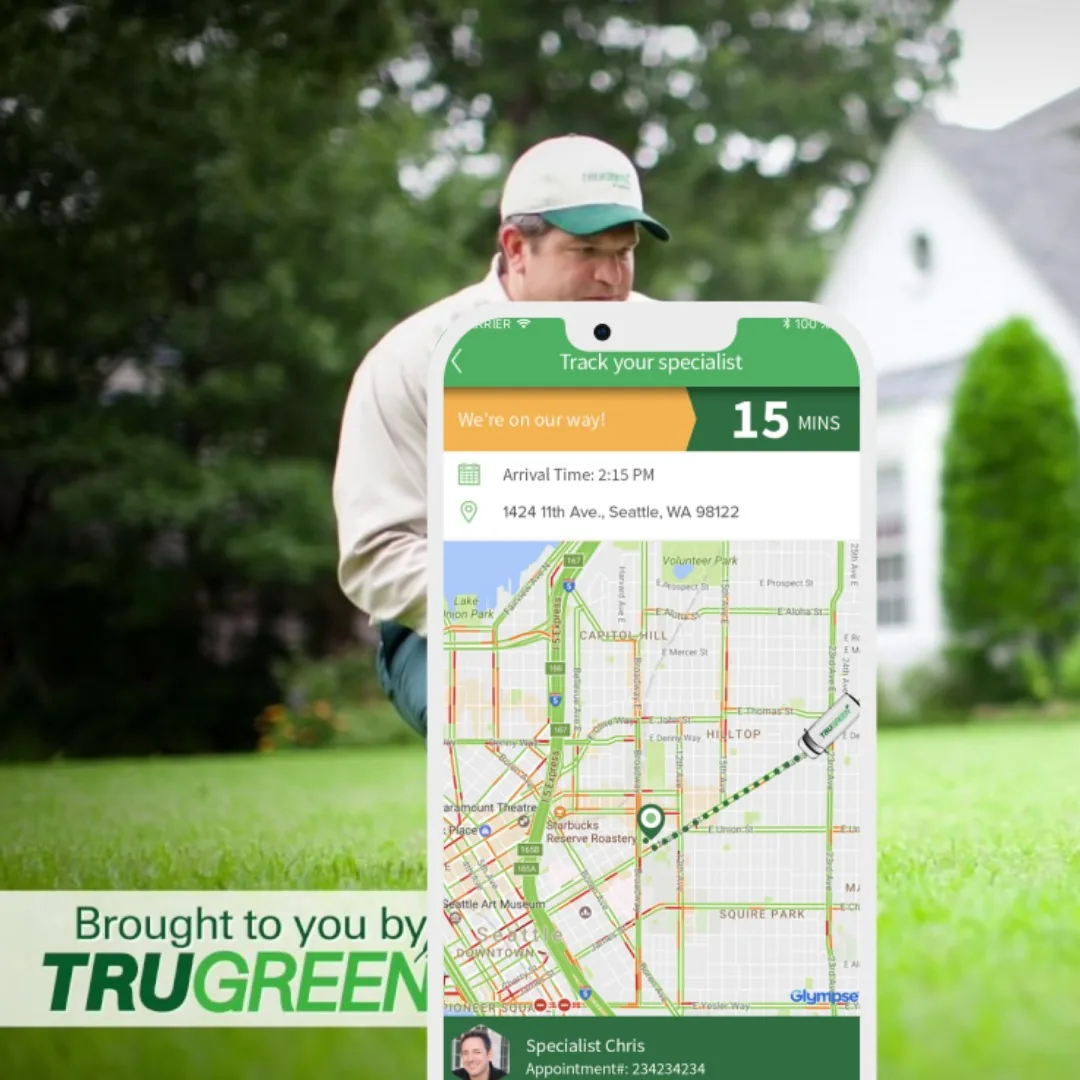
Customers were tired of getting a different technician every visit. Each rotation meant re-explaining the lawn, the history, and the concerns. So I proposed the Virtual Technician — either a virtual agent that knew the account, or their existing technician made reachable through the new app. Below is the initial sketch I started from and the concept variations I built out.
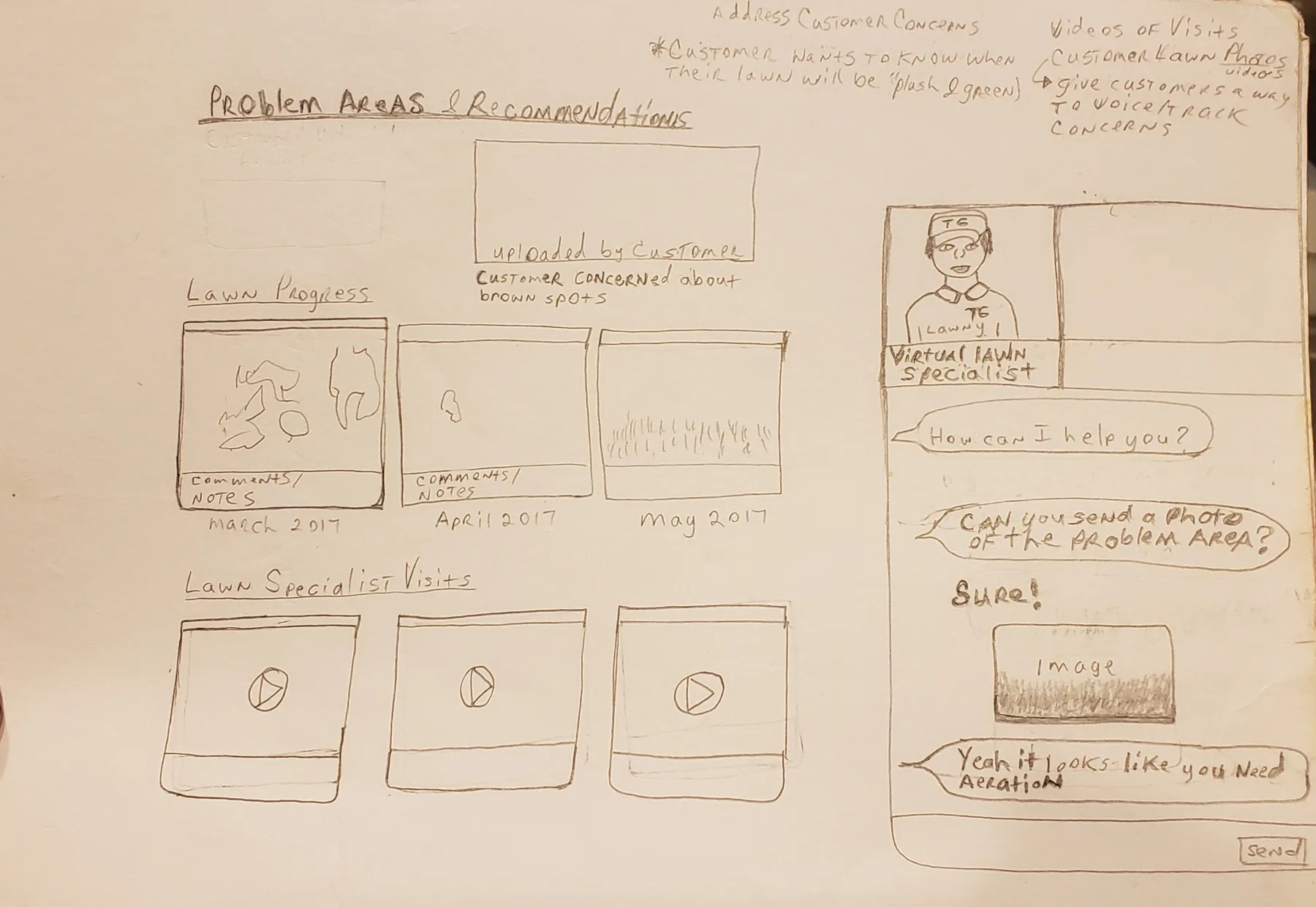



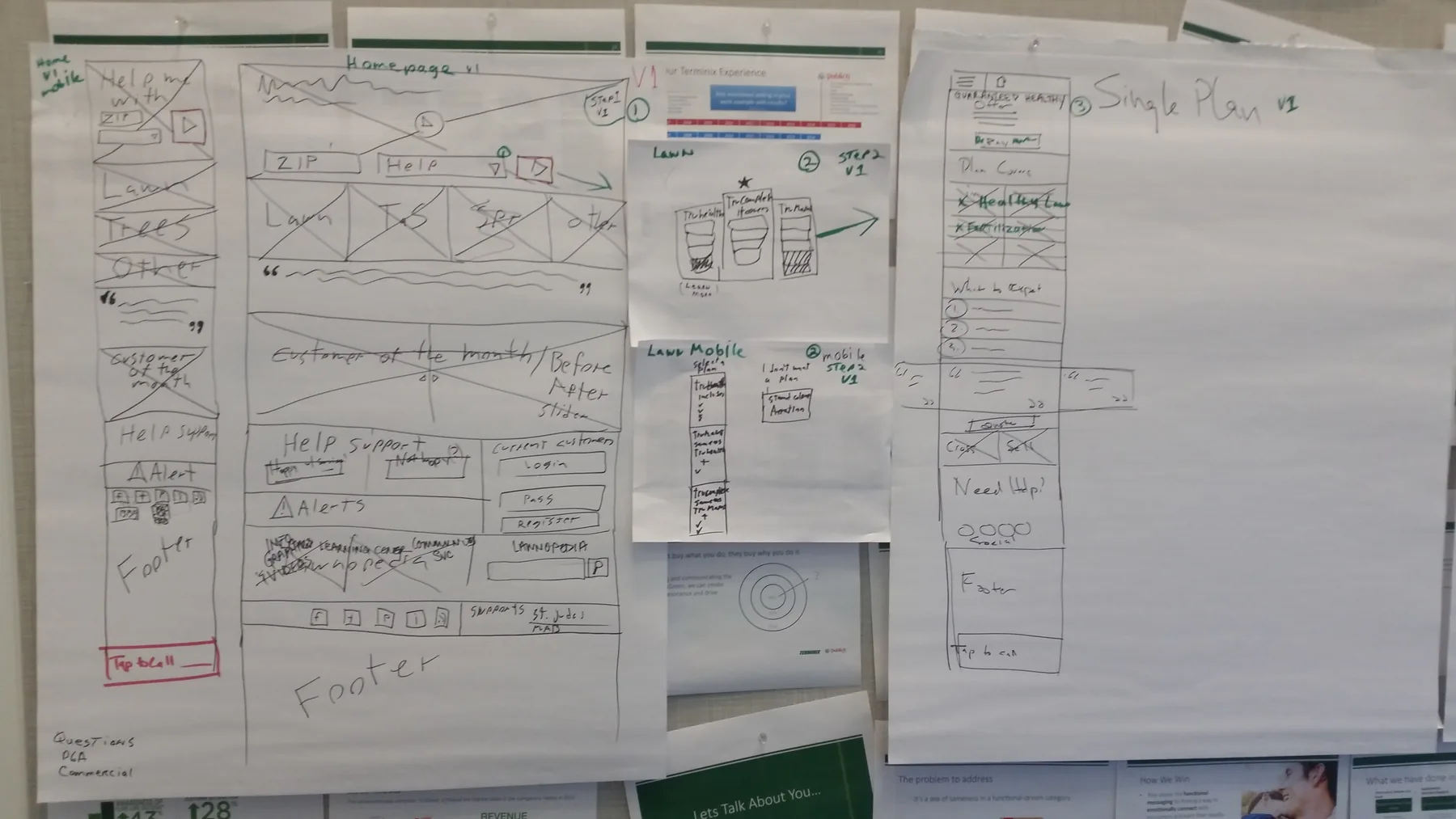
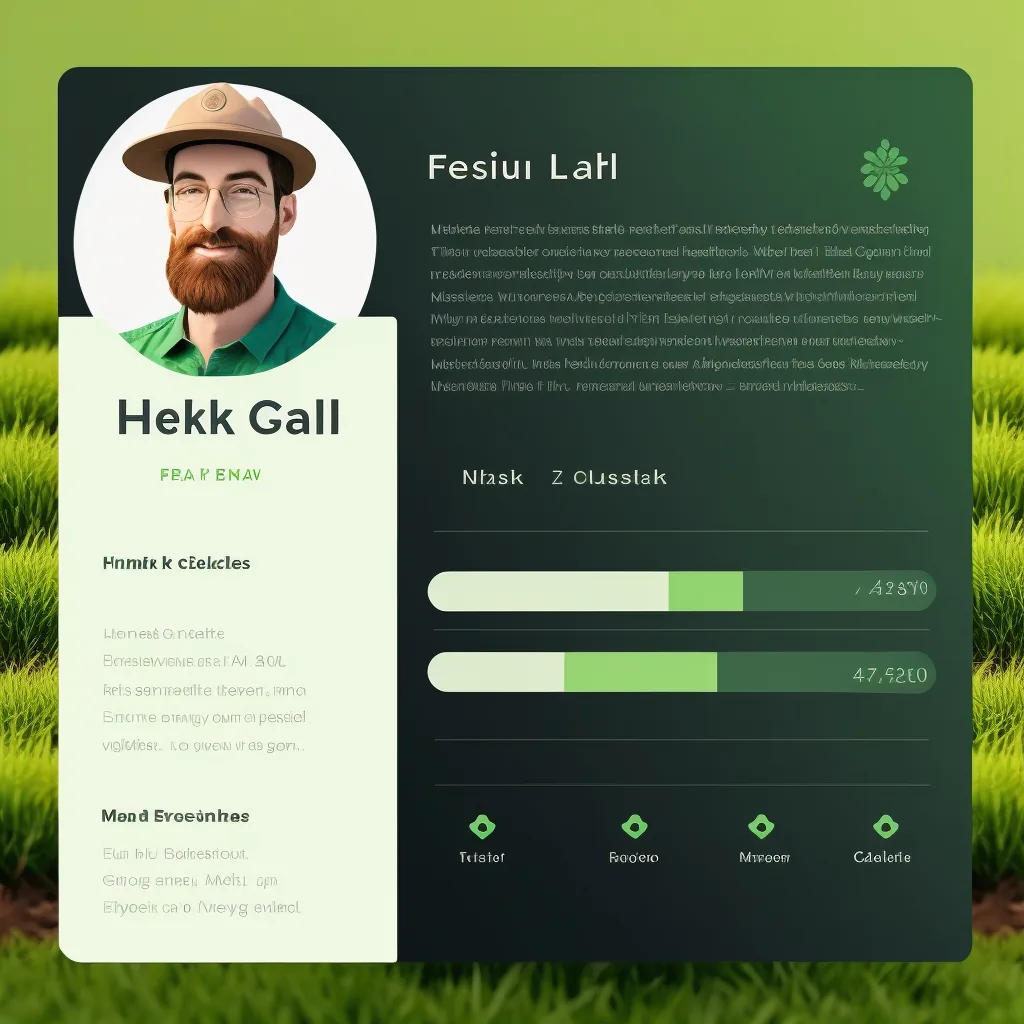
Sketches from the interviews. Personas from the search results.
The sketches came out of user interviews, the business process map, and a heuristic evaluation — kept low-fidelity so decisions kept moving and stakeholders had room to add their own ideas. The personas were rebuilt from scratch, because the ones TruGreen was designing against reflected who leadership thought their customer was, not what a real person encountered when they searched for the company online.
Have a business trying to sell something online for the first time?
Discuss an InitiativeWhere the site should live, and what it was competing with.
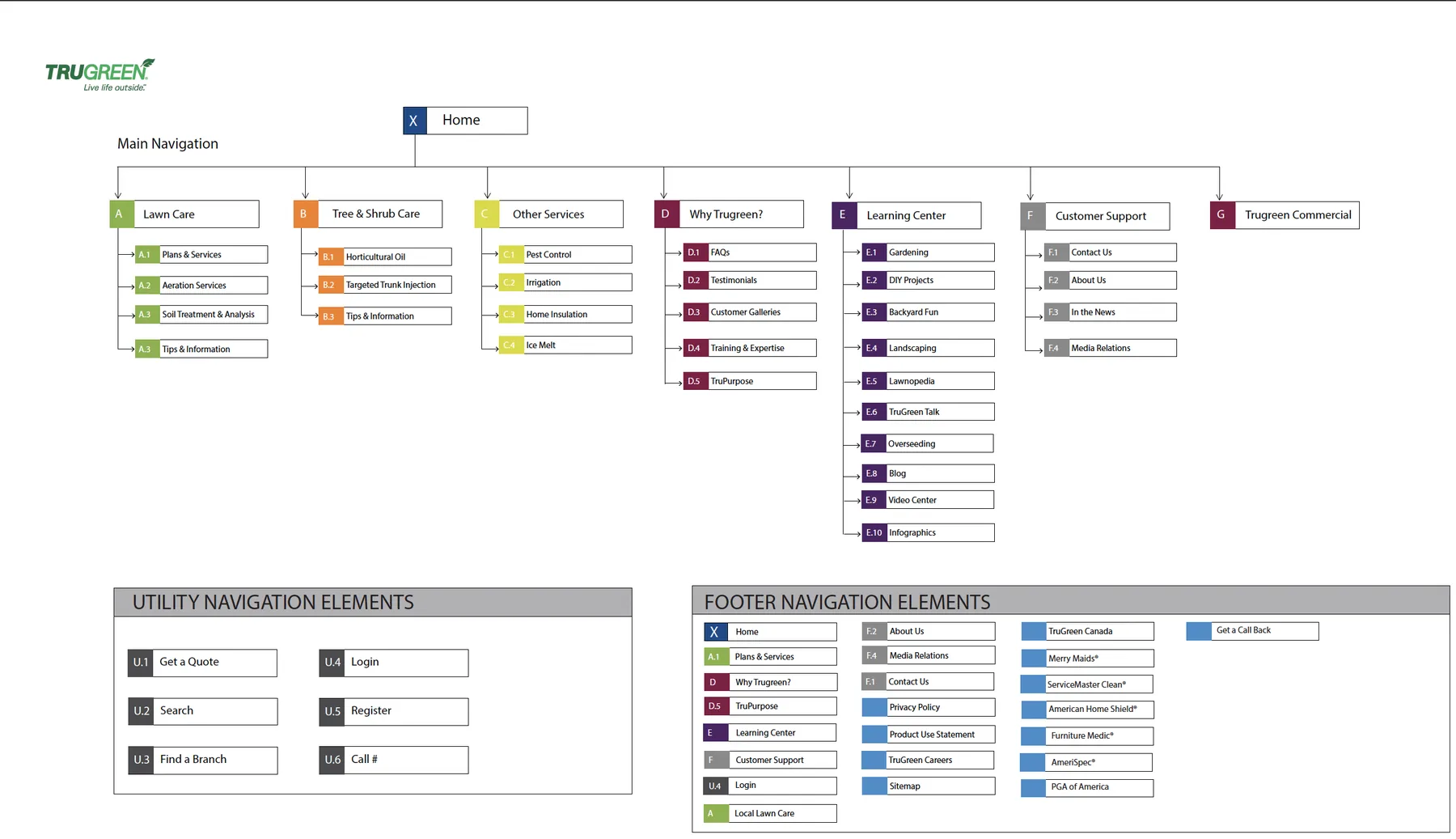
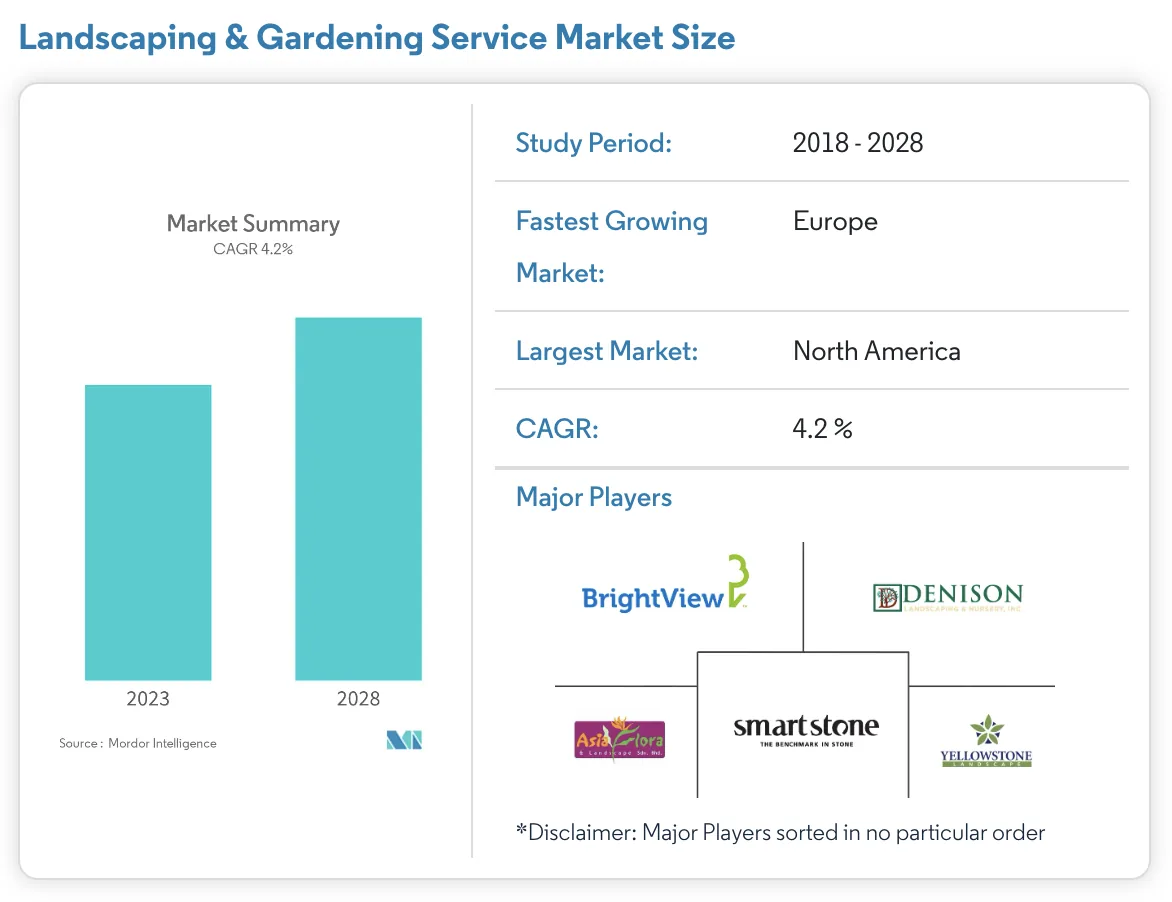
Alongside the flow work I ran a content audit and rebuilt the sitemap and navigation with the lead copywriter — the frame the shipping site would sit in. In parallel, a competitive study covered the incumbent lawn services, the startup disruptors challenging them, and where the category as a whole appeared to be heading, so recommendations were grounded in the market and not just internal opinion.
What shipped was a new buying process — not a restyle.
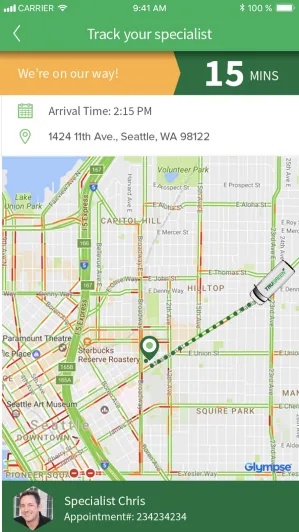
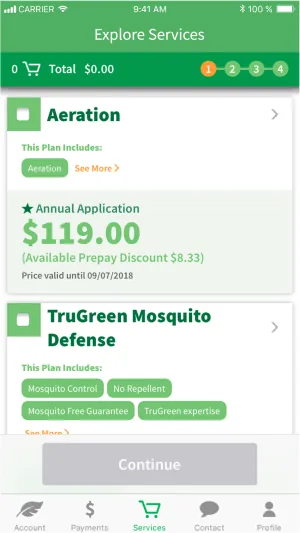
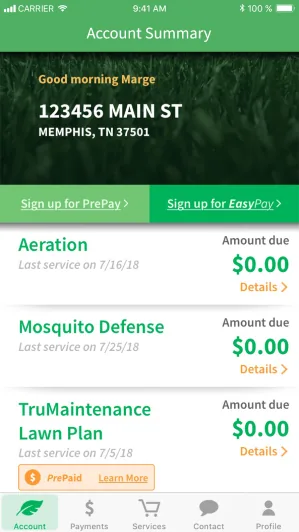
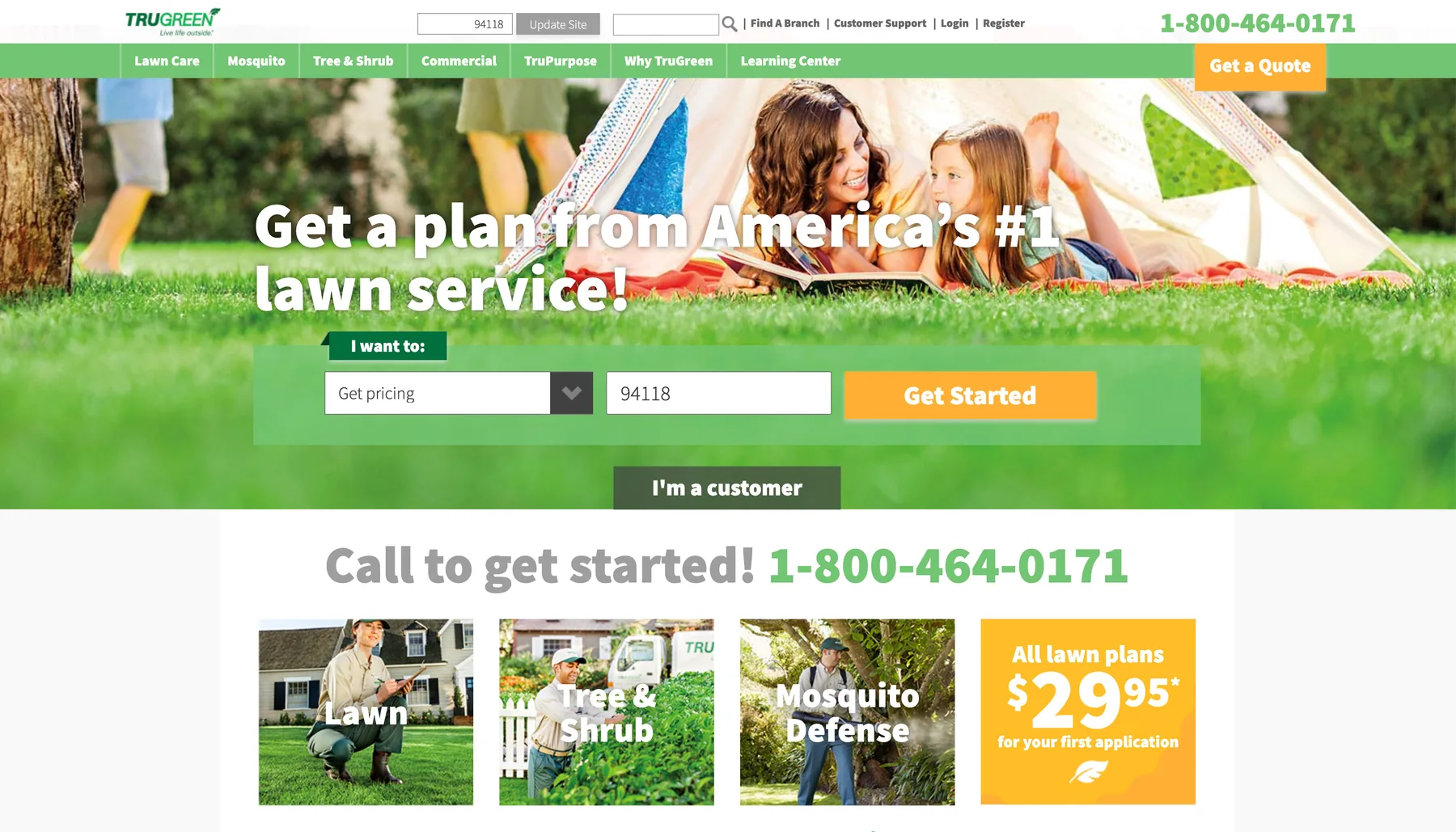
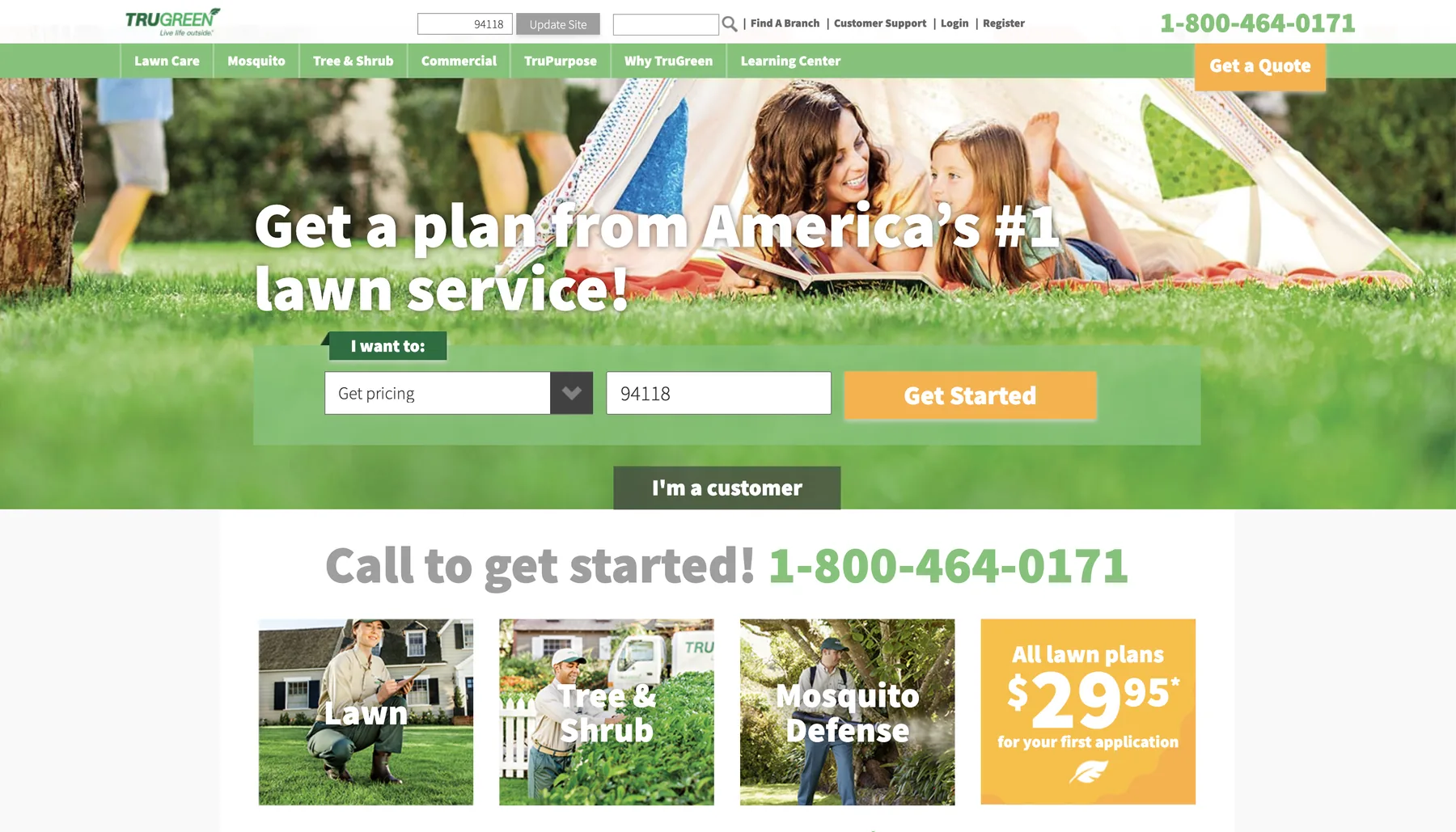
The final screens carry a buying flow that did not exist before, built from customer feedback rather than an internal opinion of what would sell. I designed them in Sketch with a visual designer on assets — iOS for the mobile app, cross-platform for the web. Below: four app screens from the buying flow, and two desktop views of the redesigned site.
TruGreen Lawn Intelligence — the modern take on the same problem.
The 2017 engagement solved a buying problem with sketches, Axure, and a Virtual Technician concept. This is what that concept looks like today: an AI-guided lawn consultation where Avery (the AI Virtual Technician) runs a structured scan of your property, Maya (a live specialist) reviews the results, and Marcus (a field specialist) arrives already knowing your lawn. Same trust problem, current toolkit. Independent concept prototype, not affiliated with TruGreen.
Interactive concept · 13-stage journey · Demo controls in the top-right skip you between stages.
Open in a new tab ↗Eight-plus months, structured so each phase changed what could ship.
The engagement was long because the research had to change what leadership believed, not just what the design looked like. Each phase produced an artifact the team could use immediately — the undercover placement came out of week two, the flow prototype came out of the design sprint, the Virtual Technician came out of the survey data, and the shipping UI grew from screens that had already been through real customers twice.
Got hired as a new sales employee in a TruGreen call center, took real customer calls, and ran 10 employee interviews in person and remotely — in 21 days.
Designed and fielded a customer survey of 500+ respondents, then synthesized the findings into what customers did not understand and what they did not trust.
Mapped the sales process end-to-end with every internal group in the room, then used the map to set product strategy and scope for the year ahead.
Built the customer journey map for executive visibility and rebuilt the personas from search-behavior and interview data rather than marketing archetypes.
Produced low-fidelity sketches with internal groups, built a fully functional Axure prototype of the new flows, and ran the first round of usability tests.
Reworked the flow around the evaluation-first pattern the tests demanded, and ran three more sessions to validate the change before scale.
Delivered sitemap, content strategy, competitive study, and final UI for the iOS app and cross-platform web, with iteration continuing through launch.
What the engagement changed about how TruGreen sold.
| Before the Engagement | After the Engagement |
|---|---|
| All sales through call centers and field technicians, with no two people selling the same way | An online sales channel — the first in company history — built around a documented, repeatable buying flow |
| Salespeople trained to pitch the highest-tier plan before knowing anything about the customer's lawn | Evaluation-first flow that mirrors what a good technician would ask, validated across two rounds of usability testing |
| Leadership belief that complex services like tree and shrub care could not be sold digitally | Complex services available online, packaged with sales and technicians to match the language customers actually used |
| Rotating technicians eroding customer trust on every visit | Virtual Technician concept keeping the customer's technician reachable and their account history in one place |
| Marketing personas that did not match the customers actually calling in | Personas rebuilt from search behavior, interview data, and 500+ survey responses |
| No shared customer journey across marketing, sales, ops, technicians, and support | A cross-functional journey map every internal group helped build — alignment as the by-product of the work |
What was delivered, and what it made possible.
TruGreen launched online service purchasing for the first time — a channel that had never existed for America's largest lawn care company before this engagement.
Complex services leadership had ruled out — tree and shrub, complex diagnostics — became available online, packaged around the language and questions customers actually used.
A buying flow built on what a good technician would ask first — grounded in undercover fieldwork, validated across two rounds of usability testing before ship.
A feature designed to solve the loudest complaint in the research — rotating technicians eroding trust — by keeping the customer's technician reachable through the app.
A single customer journey every internal group contributed to and could see themselves in — the alignment artifact TruGreen had never had before.
iOS mobile app and cross-platform web experience — final UI, IA, and content strategy — carrying the new buying process into production.
The fastest way to learn a business is to go do the work in it.
For companies opening a digital sales channel for the first time, moving from human-led selling to online, or trying to validate an executive assumption about what customers will or will not buy, the biggest risk is designing on top of a story about the business that nobody has recently tested. A few weeks embedded in the actual work — in the call center, on the truck, on the sales floor — reshapes what you build, and it pays for itself many times over.
Bring the same approach to your
first online sales channel.
If your team is opening a new digital channel, moving a human-led sales process online, or trying to test an executive assumption about what customers will actually buy, I can help you get to a validated flow in the same short arc that carried TruGreen.
Working artifacts on this page — the business process map, survey findings, journey map, sketches, personas, sitemap, competitive study, and final UI — are from the original TruGreen engagement with Publicis Groupe. Some have been lightly compressed or trimmed for legibility in a public case study, and internal identifiers have been removed. The usability session recording is used with permission; the participant is a real TruGreen customer.