Discuss an Initiative
Featured Enterprise Transformations

The problem was
never the screens.

Five engagements where the work was determining what the organization should actually build, change or prioritize — a reseller business model, a cross-company blueprint, a first digital sales channel, an operation nobody had mapped, and an AI governance product. Click any to expand.

01 · AT&T Partner Exchange

Modernizing a business model, not a portal

The Situation

AT&T was standing up a reseller channel: independent solution providers would package and sell AT&T connectivity as part of their own solutions. But the products, systems and fulfillment processes had all been built around AT&T's own direct-sales model.

What We Found

Mapping the partner's full lifecycle exposed the gap: a partner could sell and submit an order, then had no way to see what happened to it — while their own customer was asking them where it was.

What Changed

An 11-month engagement across product, sales, engineering, development and operations determined what could technically be resold, what made commercial sense, and what a partner could actually support.

75%
Faster ordering cycle · First AT&T order through an API
Read the full case study →
Before

Internal complexity shaped the ordering experience. Legacy processes were built around AT&T's internal systems, terminology and specialist knowledge.

After — BuyFlow

A guided buying experience for solution providers

BuyFlow translated qualification, configuration and ordering into a progressive workflow designed around how resellers actually built customer solutions.
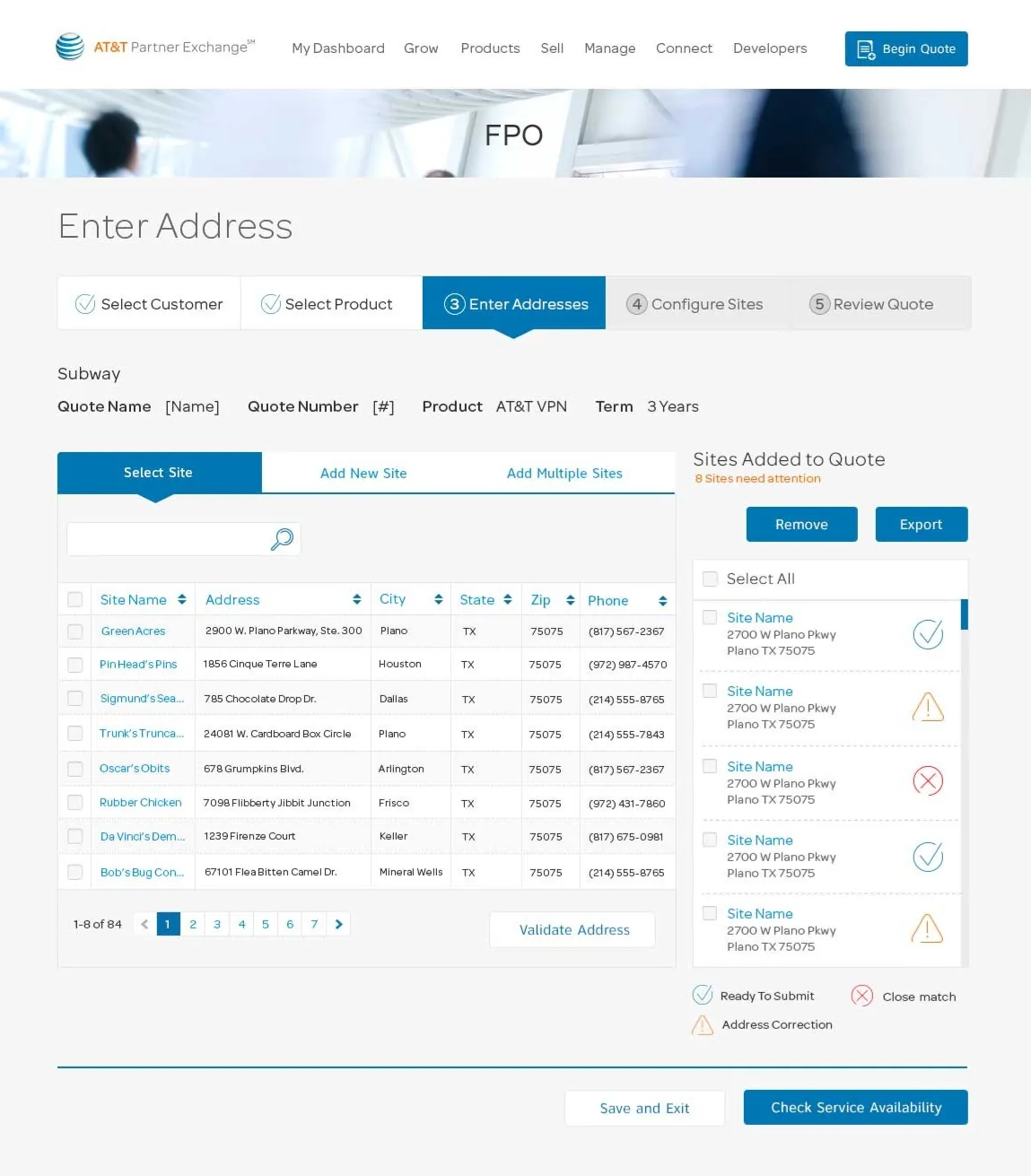
Partner Exchange BuyFlow at the Enter Address step, showing a five-step progress bar reading Select Customer, Select Product, Enter Addresses, Configure Sites and Review Quote, a searchable table of customer sites, a Sites Added to Quote panel marking each address as ready to submit, a close match or needing correction, and a Check Service Availability action.
BuyFlow — Partner Exchange ordering experience Original engagement artifact showing the guided multi-site qualification and quoting workflow. View the full artifact →
  1. 01
    Progressive workflowComplex decisions broken into understandable steps.
  2. 02
    Qualification in contextAddress validation and service availability became part of the buying flow.
  3. 03
    Designed for resellersPartners could build customer solutions without navigating AT&T's internal organizational complexity.
02 · BNSF Railway × J.B. Hunt

Blueprinting across two companies before major development investment

The Situation

An Experience Design team inside the BNSF Fort Worth Innovation Center was executing screens for Quantum, an intermodal service spanning two companies. Development investment was approaching, and the design work was moving faster than anyone's understanding of the system underneath it.

What We Found

Every team held a piece of the shipment lifecycle — customer experience, operations, systems, data, ownership — and no one held the whole. Some of what was being designed assumed capabilities that did not fully exist yet, or that belonged to teams not yet in the conversation.

What Changed

The Holistic Enterprise Blueprint connected the customer experience, operations, systems, data and ownership across both organizations. Together with the MVP and a Control Tower prototype, it gave engineering and leadership a clearer basis for estimating level of effort, planning budget and determining the expertise needed to continue development. Business Analysts were trained in UX research methods, and cross-company discovery became a repeatable process.

8 wk
To define the MVP, estimate effort and shape the delivery team
The Blueprint

One shared view of the enterprise before development accelerated

Most discovery examines these layers in isolation. Seeing all seven together is what let two organizations agree on what to build — and on what it would actually take to build it.

01
Customer Experience & Journey
What do customers actually experience at every touchpoint?
02
People, Processes & Operations
Who does the work, and what processes drive — or undermine — those experiences?
03
Systems & Technology Infrastructure
What systems support or constrain the processes in place?
04
Data, Performance & Insights
What data exists, how does it flow, and what do we need to measure to make better decisions?
05
AI & Automation Opportunities
Where would AI create real leverage — not just novelty?
06
Ownership & Governance
Who is responsible for what — and where are the gaps?
07
Business Outcomes & Strategic Roadmap
What should we actually build, fix, or prioritize — and in what order?

Holistic Enterprise Blueprint — the seven layers The model applied across BNSF and J.B. Hunt to make dependencies visible before development investment.

  1. 01 — What are we building?MVP definition made the scope concrete enough for the organization to act on.
  2. 02 — What will it take?Visible systems, data and dependencies gave engineering a basis for estimating level of effort.
  3. 03 — Who do we need?Clarified the roles and expertise required to continue development.
View the full BNSF transformation →
03 · TruGreen

Turning frontline knowledge into the company's first digital sales channel

The Situation

America's largest lawn care company had never sold its core services online. The entire sales process lived in call centers and with field technicians, and no two people sold the same way. Complex services like Tree & Shrub care were considered impossible to sell digitally.

What We Found

The real sales methodology existed inside frontline behavior, not documentation. Going undercover as a new hire in the national call center made it visible — how the best salespeople actually diagnosed a property and built an offer.

What Changed

The offline purchase journey was mapped end to end and rebuilt as a digital experience, launching online service purchasing for the first time in company history. Services previously considered unsellable digitally became available.

500+
Survey respondents behind the experience findings
Read the full case study →
04 · PepsiCo / Frito-Lay

Going into the operation to find the problem headquarters couldn't see

The Situation

The CTO team was building applications for delivery drivers without UX research. Nobody had mapped the driver's real day, and nobody had looked at what happens when the plan breaks — so the design work had no evidence to defend itself with.

What We Found

Two weeks working as a driver's assistant, filmed in VR 360 so executives could stand inside the cab. The most valuable finding was never on the schedule: a stressed driver in a Kroger whose missing shipment led back to a distribution center with no map.

What Changed

Friction that interviews had missed was surfaced and evidenced. A reconstructed delivery sheet proved the company had already codified how orders go out wrong. A cost model turned a field observation into a line item leadership could act on.

2 wk
Embedded as a driver's assistant, on the route
Read the full case study →
Additional Enterprise Experience

Other work,
in brief.

Engagements without a full case study on this site. Listed for scope and sector rather than written up in detail.

KPMG × Cranium.AI
AI governance platform — product strategy and UX research from concept through MVP
Neiman Marcus
Digital clienteling — NM Connect
GuideStone
Member experience, research and digital innovation
Deloitte
Cybersecurity product experience
PwC
Enterprise customer journey and product work
NASA / FAA
Air traffic control software programming
Organizations & Innovation Ecosystems
KPMGAT&TPepsiCo PwCDeloitteNASA TruGreenCranium.AI
Work With Us

Ready to become
the next case study?

Bring us the initiative you're trying to get clarity on. It doesn't need to be fully defined yet.

Founder-led · No commitment required to call

AT&T CAFE — the ordering environment before Partner Exchange

Full AT&T CAFE ordering screen, showing the ASR feedback form with fields for CCNA, ICSC, PON, ASR number, BAN, ECCKT circuit identifier, due date and service order status, and a note instructing the user to carry the ECCKT value into the related EVC request.