Making AT&T's network services
resellable.
Over an 11-month transformation, I worked across product, sales, engineering, development and operations to turn carrier-centric network services into a reseller experience partners could configure, price, order and manage digitally.
An introduction to the API work behind Partner Exchange.
Not a portal redesign. A business model being built.
Executive overview · detailed artifacts below
- Organization
- AT&T — Partner Exchange, Emerging Business Markets
- Industry
- Telecommunications
- My Role
- Lead Product & UX Strategist
- Engagement
- 11 months — initial 8-week discovery arc, then iterative
- Groups Involved
- Product · Sales · Engineering · Development · Operations · Network Services · Wireless · Wholesale
- Outputs
- Reseller ordering model · API-enabled order visibility · Platform assessment · Future-state journey · Executive prototypes
Partner Exchange required complex carrier services to become products solution providers could configure, price, sell and manage as part of their own customer solutions — not simply AT&T products exposed through another portal.
Partner Exchange changed who sold the service, who managed the customer and what information each party needed. Product rules, qualification, ordering, fulfillment, support and visibility all had to adapt around that new relationship.
I conducted a technical assessment of the existing ordering technology and determined that its architecture would constrain the faster, more responsive reseller experience we were trying to create. Because Salesforce was already part of the commercial sales process, I recommended moving the ordering experience onto Salesforce — a stronger foundation for a more modern ordering experience, faster access to information and more responsive workflows.
I introduced a cross-functional product-development approach that brought customer need, business value and technical feasibility together earlier — helping teams validate opportunities before committing significant development effort.
BuyFlow translated AT&T's internal telecom complexity into a workflow solution providers could use to qualify locations, configure services, price solutions, validate requirements and submit viable orders.
Field research revealed that solution providers also needed visibility after submission so they could manage their own customer relationships. That discovery contributed to Order Status Manager, API-enabled order-status visibility and a broader API-driven ordering model.
A reseller business model exposed a bigger product problem.
Partner Exchange put a solution provider between AT&T and the end customer. The reseller — not AT&T — would own that relationship, and would need to sell, configure, order and support network services like AT&T Switched Ethernet (ASE) as part of its own offering. Nothing in the existing model had been built for that, so three things had to change at once.
The challenge wasn't simplifying ASE. It was making ASE resellable.
Ordering required telecom expertise.
Traditional ASE access ordering exposed the mechanics of telecom fulfillment directly to the user — specialized serviceability processes, ASRs, circuit identifiers, EVC requirements and provisioning workflows, all built around AT&T's traditional operating model.
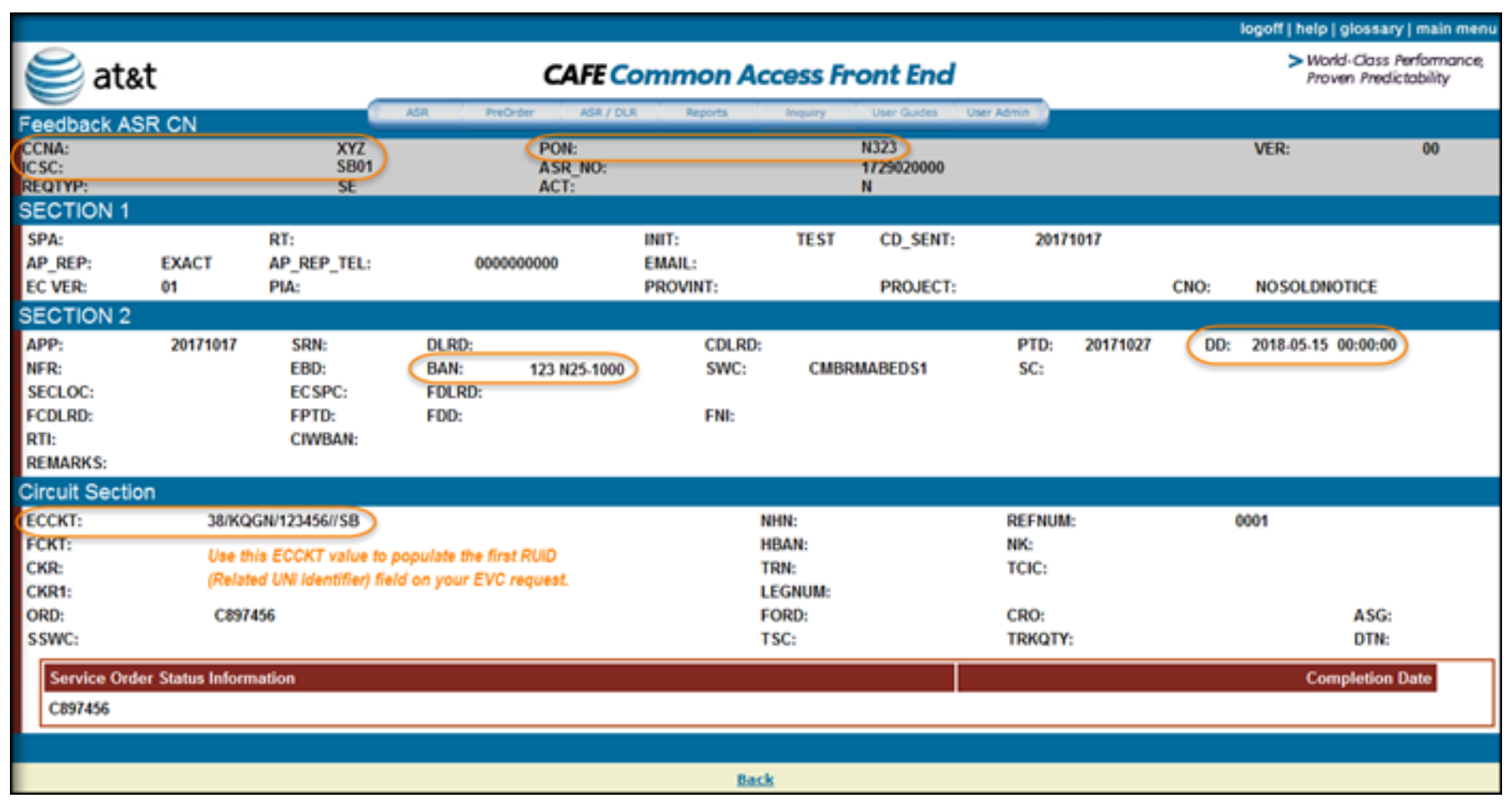
The work moved through specialized systems and organizational handoffs, and a reseller's visibility into it was fragmented.
A new business model required a new ordering model.
The reseller — not AT&T — owned the end-customer relationship.
Partner Exchange needed to translate AT&T's product, commercial and operational complexity into an experience a solution provider could actually sell through.
Design the network, not an order form.
Partners were being asked to fill in an order form when what they actually had in front of them was a customer's network. The redesign starts where they start — with the solution they need to build — and lets topology, sites and bandwidth be established before any of it becomes an order.
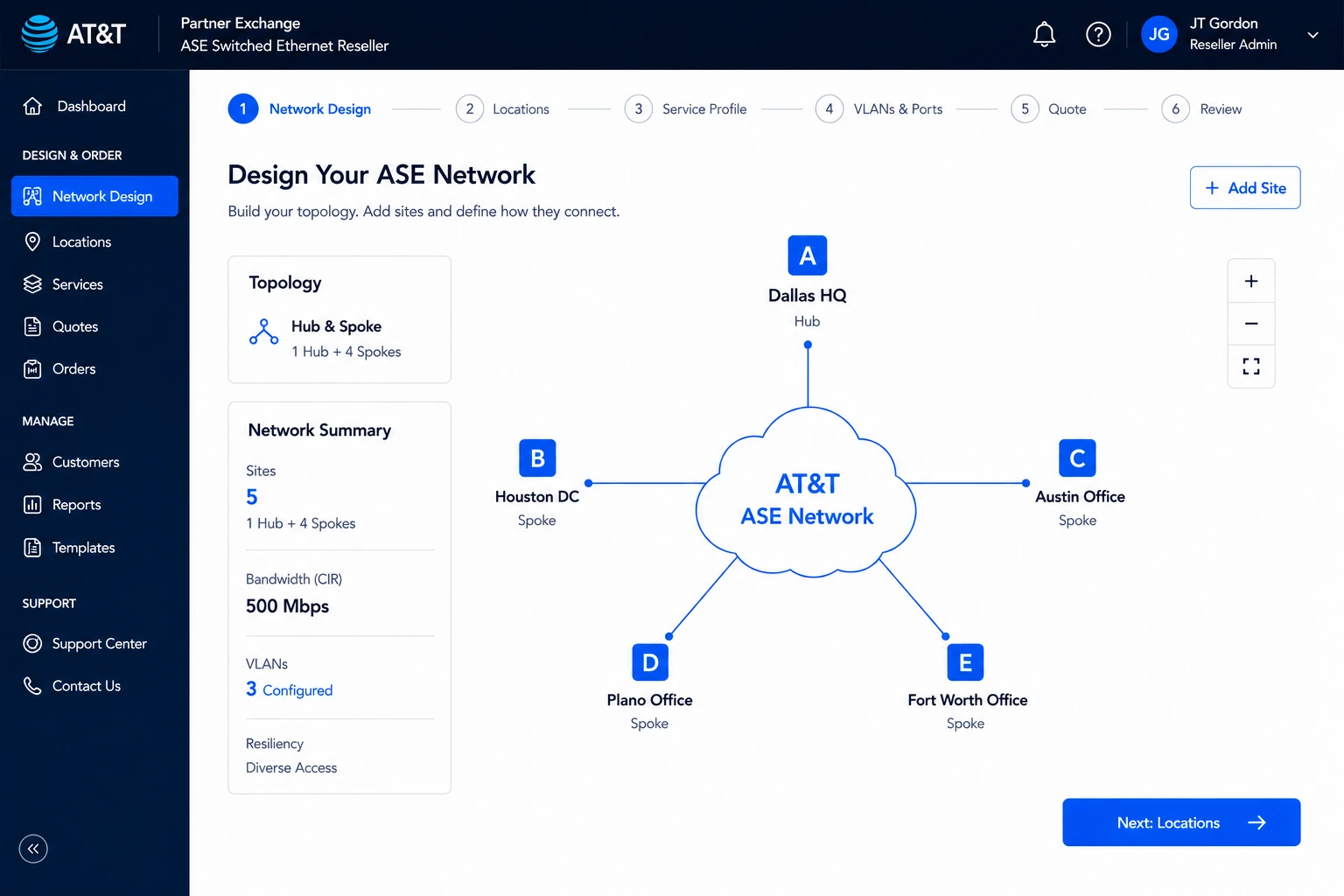
We weren't redesigning an order form. We were determining how an AT&T product could become a reseller product.
Take AT&T Switched Ethernet. A Partner Exchange customer wants to resell it. The existing ASE service may work perfectly well inside AT&T's traditional business model — but that does not automatically mean it works as a reseller product. Before an interface could be designed, much deeper questions had to be answered, and they could only be answered together.
- How would the reseller make money?
- What pricing and commercial rules were required?
- Which parts of the service could realistically be resold?
- What responsibilities belonged to AT&T versus the reseller?
- What could existing systems support?
- What had to change?
- What could be exposed through APIs?
- What information was required to correctly configure the network?
- How would qualification work?
- How would an order move through AT&T?
- How would exceptions be handled?
- What happened after the reseller submitted the order?
- What did the reseller need to understand?
- How could complex network engineering decisions be made understandable?
- What could be automated?
- Where was human intervention still necessary?
Only once those questions were answered could we build the interface and the process that let the service actually be sold.
The seat between the business, the systems and the customer.
- Product Strategy
- UX Architecture
- Research
- Business-Model Design
- Cross-Functional Product Development
- Facilitation
- Technical Strategy
- Prototyping
Interface work came after the product questions were answered, not before. Technical assessment, a day inside a customer's environment, and a journey every internal group helped build all preceded the screens. That sequence is why the work held up: the design was the answer to a problem the whole program had come to see the same way.
Learn about the framework →I led the product and UX work as a consultant on the Partner Exchange team, working across AT&T with product leaders, developers, engineers, researchers, business analysts and other specialists. My role was intentionally broad: depending on what the program needed, I moved between product strategy, UX architecture, research, business analysis, technical assessment, facilitation and delivery — often acting as a coach and connective layer across disciplines.
In practice, I sat between the business, the technology and the customer. Much of the value was not simply producing artifacts. It was helping people with different expertise develop a shared understanding of what solution providers needed, what AT&T could technically deliver, what made commercial sense, and how those decisions should come together in the product experience.
My software-engineering background was an important part of that role. Earlier in my career, I specialized in enterprise Java development and co-authored Java 2 Enterprise Edition 1.4 Bible, including the chapters on web services. That experience gave me a working understanding of enterprise integration and the technologies behind service-to-service communication, allowing me to evaluate platform constraints, integration requirements and API feasibility — not just the interface layer.
That meant asking the right questions, bringing the right specialists into the conversation, challenging assumptions, helping teams evaluate tradeoffs and turning decisions into product direction, workflows and experiences that could move into delivery.
I helped the organization see the whole system, identify what needed to change, and align the people capable of changing it. Ultimately, my role was to help the team make better decisions, move through ambiguity and turn a complex enterprise problem into something the organization could execute.
- Reseller product strategy
- Business-model definition
- Prioritization
- Field research
- Journey architecture
- Experience strategy
- Platform assessment
- API requirements
- Technical feasibility
- Cross-functional facilitation
- Executive prototyping
- Development-ready prototypes
Changing how Partner Exchange built products.
The transformation wasn't limited to what we built. It changed how we decided what to build.
When I joined Partner Exchange there was no consistent product-development process for taking an opportunity from idea through validation, prioritization and delivery. Enhancements could evolve before the underlying customer need, business value or technical feasibility had been fully validated — creating rework, ambiguity and competing priorities.
I proposed and led the creation of a shared product-development model that brought customers, business stakeholders, product, UX, engineering and development into a repeatable decision-making lifecycle. Validate earlier, prioritize more intelligently, and focus the team on the work that created the greatest value.
-
01Identify
Opportunities & ideas
-
02Validate
Research & stakeholder input
-
03Assess
Feasibility & viability
-
04Prioritize
Value, effort & impact
-
05Build
Design, develop & deliver
-
06Learn
Measure, validate & iterate
Scroll to see all six stages
- Customers & Partners
- Sales & Business Stakeholders
- Product Management
- User Experience
- Engineering & Architecture
- Development & QA
I initiated and facilitated this shared process to replace inconsistent product development with a repeatable model for validating opportunities, assessing feasibility and prioritizing the work that created the most value.
It gave individual team members clearer expectations, gave stakeholders a structured way to contribute, and helped the organization make more deliberate product decisions before committing development resources.
This is also why my role regularly extended beyond traditional UX responsibilities. I sat in sales, engineering, product and development discussions to answer questions like these — and the answers shaped BuyFlow, network-service ordering, API capabilities and the post-order experience.
- Is this something the reseller actually needs?
- Does it create enough customer and business value?
- Can AT&T technically support it?
- What product or operational changes would be required?
- Can it be sold profitably through the Partner Exchange model?
- Should we build it now, or prioritize something more valuable?

Excerpt from the cross-functional product-development process I initiated and facilitated with the Partner Exchange team. The validation cycle sits early, before build — the branch marked wasted work prevented is the point of the whole model.
I didn't just help the team build a better product. I helped establish a better way of building products.
Three decisions that changed the program.
The breakthrough wasn't a single interface. It came from changing the technology foundation, the buying experience and the visibility partners had after an order was submitted.
The experience we needed couldn't be built effectively on the existing platform.
Early in the engagement, I conducted a technical assessment of the technology supporting the ordering experience. The existing architecture had been designed around AT&T's internal processes, and was not well suited to the faster, more responsive experience solution providers needed when configuring and reselling services to their own customers.
Because Salesforce was already being used within the commercial sales process, I recommended moving the ordering experience onto Salesforce, and aligning the product experience more closely with the platform supporting the sales relationship.
That decision changed what we were able to deliver. Rather than continuing to design around the limitations of the existing technology, the team had a stronger foundation for a modern reseller experience — faster access to information, more responsive interactions, and better integration with the evolving commercial workflow.
- Step 01Technical assessment of the ordering technology
- Step 02Platform constraint identified
- Step 03Salesforce recommended
- OutcomeModernized ordering foundation
Turning telecom complexity into a guided buying experience.
BuyFlow translated AT&T's internal product, qualification and ordering complexity into a guided workflow solution providers could use to configure, price, validate and submit viable customer solutions.
Rather than exposing partners to AT&T's organizational complexity, the experience progressively surfaced the information and decisions necessary to successfully place an order.
The Salesforce decision created a more appropriate foundation for delivering this workflow. It did not define it — what a partner should be asked, in what order, and what could be decided on their behalf was product and UX work.
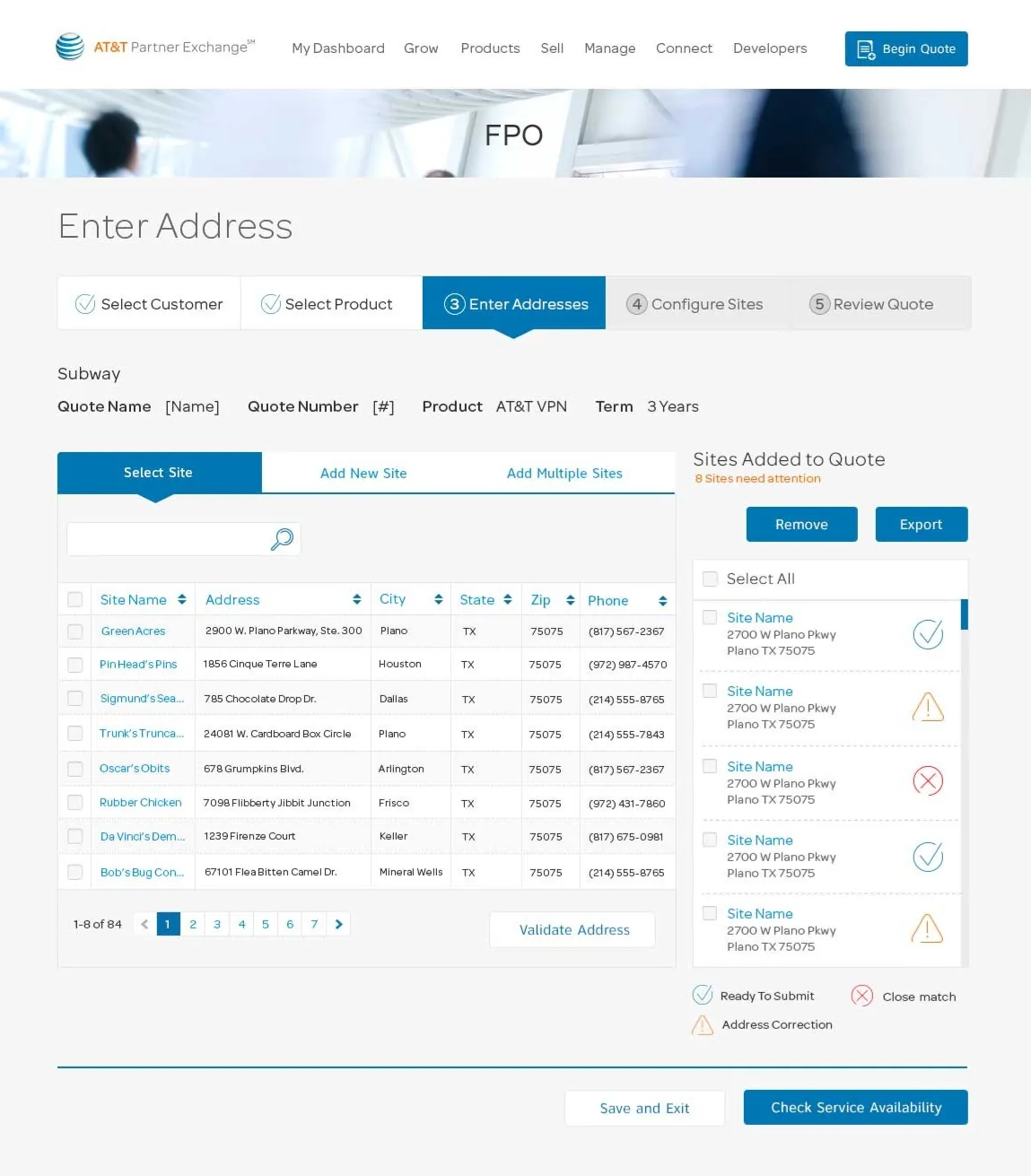
Giving partners visibility after the order.
Field research revealed another critical gap. Placing the order wasn't enough. Solution providers owned the relationship with their customers, but once an order entered AT&T's fulfillment process they lacked the visibility needed to answer one of the most basic customer questions: "where is my order?"
That insight led to Order Status Manager and API-enabled order visibility, giving partners greater control of the customer relationship after an order was submitted.
It came out of understanding the reseller operating model, not from a feature request anyone had written.
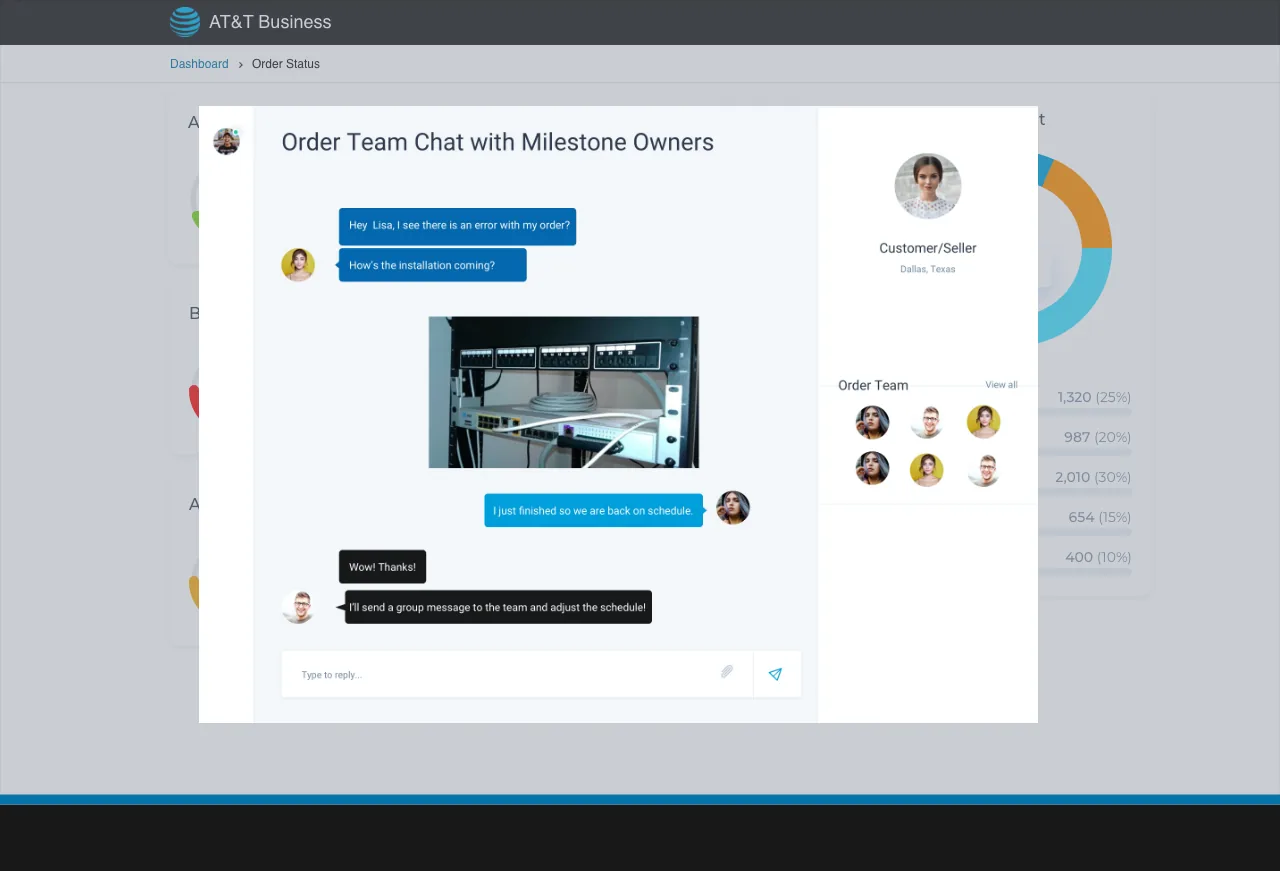
Each decision made the next one possible. The platform carried the experience; the experience exposed what was missing after the order.
- Technology foundationSalesforce — a more responsive platform
- Buying experienceBuyFlow
- Post-order experienceOrder Status Manager
- What it all servedThe reseller owns the customer relationship
Watched them work, instead of asking them to describe it.
AT&T's customers were doing AT&T's work in tools AT&T did not provide. I found that by spending a day alongside network engineers and other portal users — screen recorders and cameras running rather than a clipboard of questions — because the accurate answer to "how do you use this?" is almost never the one people can narrate in real time.
- Customers relied on tools outside AT&T systems to complete AT&T work.
- A Salesforce app that integrated with Excel — a tool most customers already lived in — became the bridge into their real workflow.
- Customers had no way to monitor the status of orders they placed in the portal, and support calls filled the gap.
- The single request that came back most often, in the customers' own words, was "just let us see what's happening."
"The future of AT&T business is in your hands, JT Gordon."
Where the reseller business model became real.
The BuyFlow was the point where AT&T's new reseller model had to become operational. A solution provider needed to move from a customer's network requirement to a valid, commercially viable AT&T order without becoming an expert in every internal ordering system and provisioning dependency.
Take AT&T Switched Ethernet. It already existed as a product — built around AT&T's own sales, engineering, fulfillment and support processes, none of which assumed a third party in the middle. Making it sellable through a partner meant working the whole chain, and none of it could be answered by design alone.
- Reseller need
- Existing AT&T product & operating model
- Cross-functional product decisions
- Business & technical rules
- BuyFlow, APIs & support model
- Reseller-ready service
Inside the BuyFlow, that chain resolved into five decisions a partner had to be able to make in sequence — each one crossing AT&T product organizations and internal systems.
Can AT&T deliver the service at the required locations?
What network, bandwidth, topology, port, EVC and feature combinations are valid?
What can the reseller sell, under what pricing and commercial rules?
Does the proposed solution satisfy technical and operational dependencies?
Can the configuration be translated into a valid AT&T fulfillment request?
My role was to help turn those dependencies into a coherent reseller product experience. The BuyFlow governed how an order got in. The next problem was how visibility got out.
The missing half of the BuyFlow.
BuyFlow solved how a reseller could place an order. Field research exposed the next problem: once the order entered AT&T fulfillment, the reseller did not have the level of visibility it needed to manage its own customer relationship.
Because the reseller — not AT&T — owned the end customer, that gap was a product problem rather than an inconvenience. Customers would ask the reseller "where is my order?" and the reseller needed an answer. I identified this missing capability and initiated the effort to solve it.
- Reseller submits order
- AT&T fulfillment systems
- Status distributed across operational systems
- Limited reseller visibility
- Support calls and escalation required
AT&T held the status information internally. What the reseller lacked was a route to it — so the answer came by support call, escalation and uncertainty around installation dates, eroding the partner's credibility with their own customer.
- Reseller submits order
- AT&T systems
- Normalized order-status data
- API-enabled Partner Exchange visibility
- Reseller can manage their customer proactively
Visibility turns a support burden into an account-management capability: the partner answers their own customer instead of reactively chasing AT&T.
Order-status monitoring was not part of the original request. It came out of understanding the partner's whole lifecycle rather than optimizing the task directly in front of us.
AT&T later announced an Order Status Tool for Partner Exchange solution providers, giving them daily status updates on a customer's order with 24/7 system access for enabled products and services. A MetTel executive said publicly that the recently released tool had already increased their productivity.
Finding where the answer already lived.
Identifying the gap was the easy half. Order status did not sit in one place — it was spread across the systems that owned different stages of fulfillment, in formats that had never been meant to leave AT&T. So I brought together a group spanning Partner Exchange and the relevant teams across the wider AT&T organization to work out how visibility could actually be delivered.
That meant establishing which systems owned which part of fulfillment, what could be exposed externally, how status should be normalized across sources, what a partner genuinely needed to see, and how APIs could carry it into the Partner Exchange experience. The innovation was not creating the data. It was making it useful inside the reseller lifecycle.
Order status and milestones through fulfillment
Exceptions, jeopardies and issue resolution
Keep the reseller and their customer informed
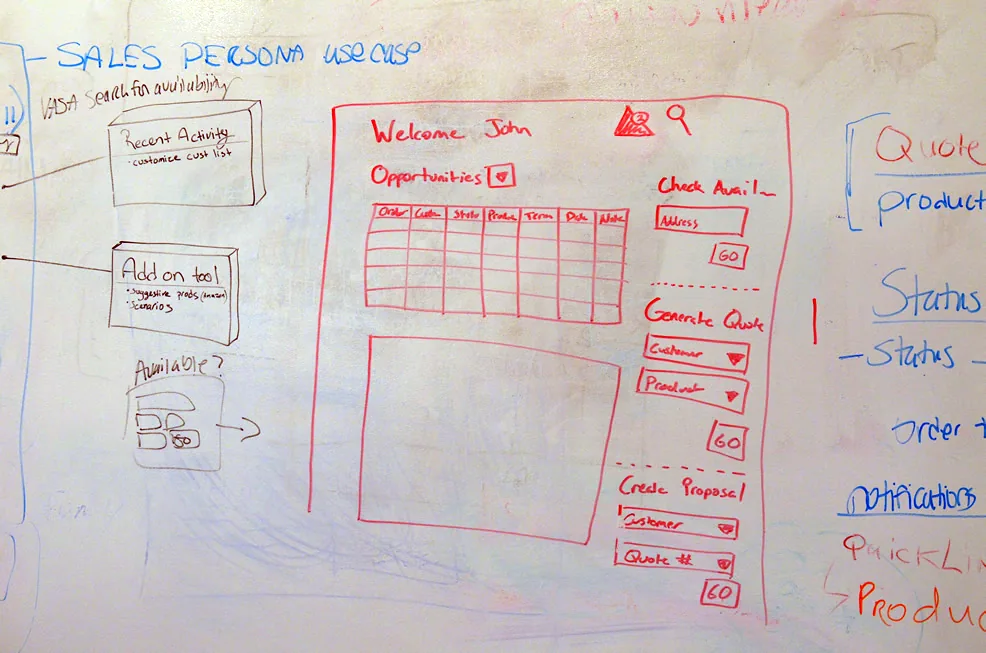
Interface work came late in this engagement by design — with one deliberate exception. The order-status concept shown earlier was built first, because leadership needed something they could pick up and react to before the rest of the work could be funded.
AT&T order placed through an API — from a customer need surfaced in field research.
Order status monitored through Partner Exchange, exposed to partners through APIs.
The team received internal AT&T recognition for the innovation.
Have an enterprise program where the platform is fighting the design?
Discuss an InitiativeFrom network intent to a valid AT&T order.
Enterprise Ethernet is not a simple product purchase. A partner has to turn a customer's requirements into locations, topology, bandwidth, resiliency, ports and network services — and the legacy process made them do it one site at a time. What follows is a modernized reconstruction of the ordering experience — seven stages showing how the research, business rules and design principles translate from network design through pricing, submission and provisioning.
Prototyping as a decision tool.
Design artifacts on this engagement existed to force decisions, not to present them. Three of them did most of that work.
A senior vice president was arriving mid-iteration and the wireframes on the wall would not carry the room. An HTML prototype coded overnight carried the executive review and helped preserve program momentum. The internal name the AT&T team used afterwards was "Mr. Make It Happen."
Axure prototypes could be changed inside working sessions, so cross-functional teams argued against something tangible rather than against a description.
High-fidelity prototypes gave developers concrete behavior and interaction models to estimate and build against — an exact reference, not a description.
One shared view of the reseller lifecycle.
Not everything moved to Salesforce. A great deal was reworked around what the channel actually required, and some reseller requirements needed broader process and API changes instead of a platform answer.
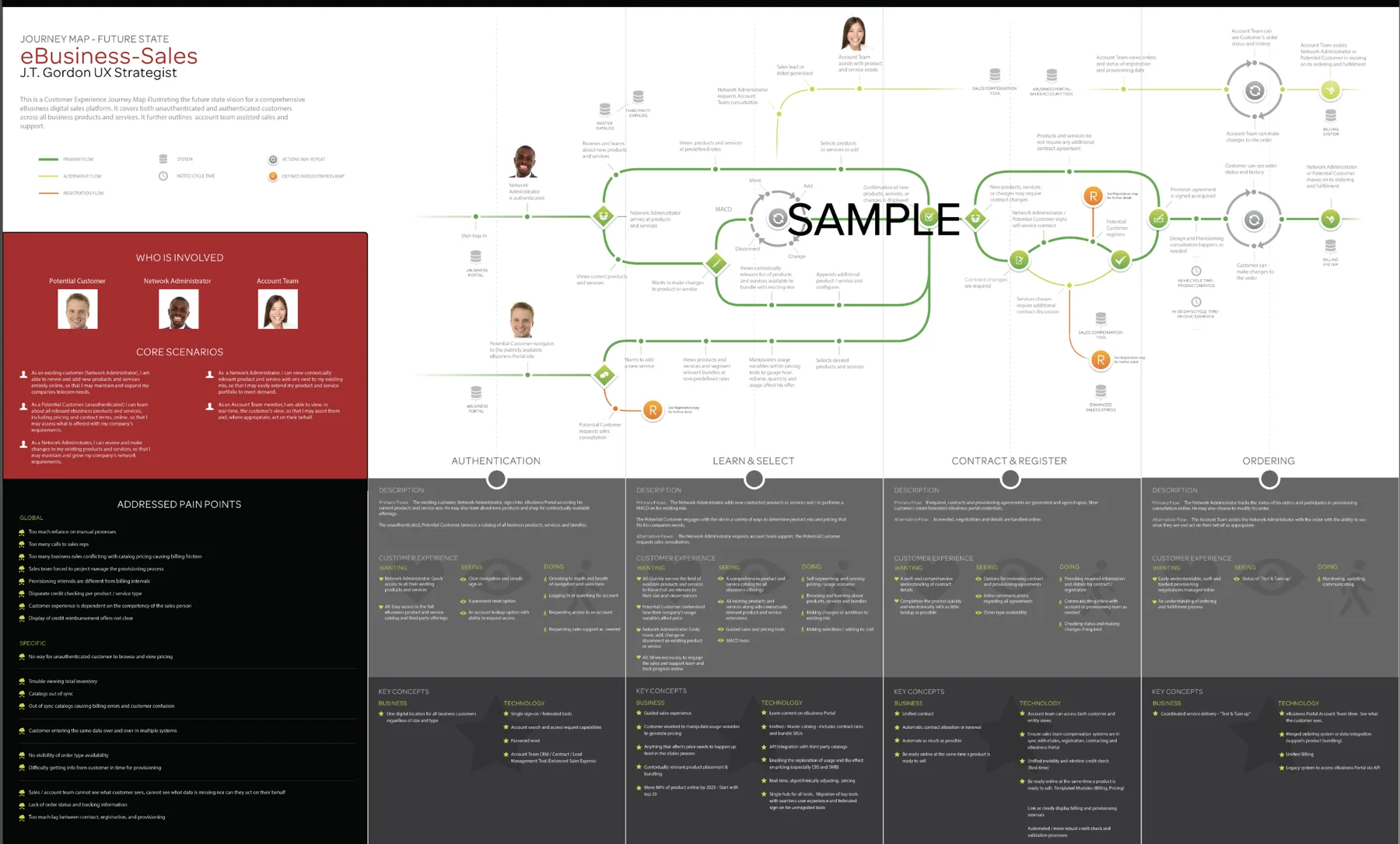
The future-state journey brought ordering, provisioning, billing, support and network operations into one shared view of the reseller lifecycle — which is what made those decisions arguable across teams rather than assumed.
Eleven months, and none of it in a straight line.
There was no clean handoff from research to design to build. Product viability questions reopened technical ones. Technical constraints changed what was commercially sensible. Customer findings sent the team back to product teams who had already signed off. The work moved between those modes repeatedly, and often at the same time — iteratively, across network, wireless, wholesale and other AT&T product teams, over the full 11 months.
What was delivered, and what it made possible.
Engagement outcomes
Not a layout improvement. The gain came from simplified workflows, removed handoffs, better information visibility, platform and technical changes, automation, API integration, and aligning the process with how a reseller actually works. The system was redesigned around the work — not just the screens around the system.
A customer need surfaced in field research — programmatic ordering — became the first API order in the company's history. APIs and microservices are now at the heart of AT&T's digital transformation work.
Partner Exchange was able to offer reseller order-status monitoring through an API, from a gap identified in research rather than a requirement anyone had written — visibility that had not previously been available to the reseller in this form.
The cross-functional team behind the order-status capability received internal AT&T recognition for the innovation.
The technical assessment made the case for moving ordering onto Salesforce, the foundation the experience work depended on, and the overnight prototype carried the executive review that kept the program funded.
Program-level experience result
AT&T Partner Solutions leadership later described the transformed Partner Exchange experience as having reduced cycle times by 75% and earned one of the highest Net Promoter Scores in the industry.
This is a program-level result for the wider Partner Solutions transformation, not an outcome attributed to any one contributor.
Subsequent program momentum
The model continued to scale.
Subsequent Partner Exchange program-level results are shown as context for the program's broader trajectory and are not attributed solely to this engagement.
The interface was the output. The transformation was the work.
Partner Exchange required more than a better interface. It required rethinking how existing AT&T products, systems and processes could participate in a new reseller business model. My role sat at the intersection of customer needs, business viability and technical feasibility — helping teams turn that complexity into services partners could actually sell, manage and support.
The most expensive mistake in work like this is designing for months on a platform that will never carry the experience, or building from requirements that never saw the customer's real day. The full engagement ran 11 months. The discovery that unlocked it — platform assessment, field research, executive prototype — was a matter of weeks. A short, grounded discovery pays for itself many times over.
Business strategy, product decisions, engineering constraints, APIs, ordering, fulfillment and customer experience had to resolve into one system — the BuyFlow that let partners transact, and the missing post-order capability that became API-enabled order-status visibility. That is still the kind of problem I focus on.
Turn an ambiguous enterprise initiative into an aligned, validated path to delivery.
Media Visionary helps organizations define the right opportunity, align stakeholders, validate customer need and technical feasibility, redesign the experience and the operating model, and turn the result into a clear path to delivery.
Every engagement is led directly by the principal. For complex initiatives, Media Visionary assembles the right mix of product, UX, research, engineering, data and specialist expertise around the work.
- Enterprise platform modernization
- Partner & channel ecosystems
- Complex B2B products
- Product operating-model transformation
- API-enabled experiences
- Legacy process modernization
- Cross-functional product discovery
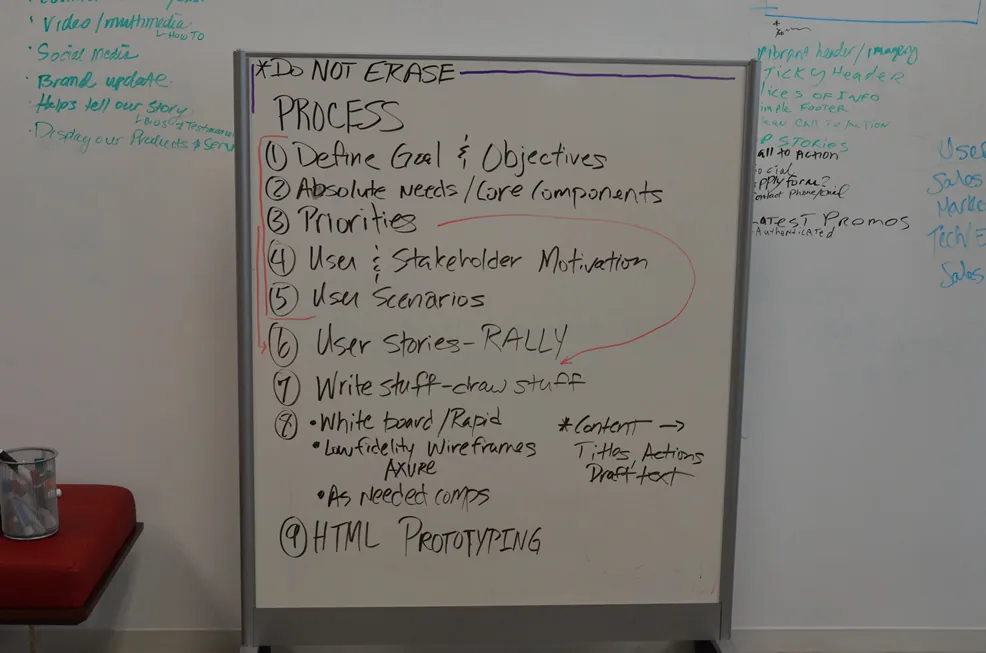
Working artifacts on this page — the product-development process diagram, working-session whiteboards, journey map, BuyFlow screen and order-status concept — are from the original AT&T Foundry Partner Exchange engagement. Some have been lightly compressed or trimmed for legibility in a public case study, and internal identifiers have been removed. Quoted feedback is verbatim from the AT&T team.
The seven ordering screens in The Ordering Experience are modernized reconstructions, created for this case study to illustrate the workflows, business rules and design decisions developed during the engagement. They are not screenshots of the original production system and are not current AT&T production interfaces. The sites, addresses, pricing, customer names and order identifiers shown in them are illustrative.
The diagrams in The Real Design Problem, The BuyFlow and Order Status Manager are explanatory illustrations drawn for this case study, not original engagement artifacts.
Outcomes listed under Engagement outcomes are firsthand project results. Items under Program-level experience result and Subsequent program momentum are publicly reported results for the wider AT&T Partner Solutions and Partner Exchange programs, cited to their sources and shown as context for the program's trajectory — they are not claimed as outcomes of this engagement alone. Where this page refers to AT&T's later or present-day direction, that is publicly available company information.